
The Bamboos and Turtledoves (竹林鹱鸽图) is a seminal masterpiece attributed to Huang Quan (黄筌), the preeminent court painter of the Former Shu and Later Shu periods during the Five Dynasties and Ten Kingdoms. This work stands as a quintessential representation of the "Huangjia Fugui" (黄家富贵) style, which set the standard for Imperial Academy flower-and-bird painting for centuries.
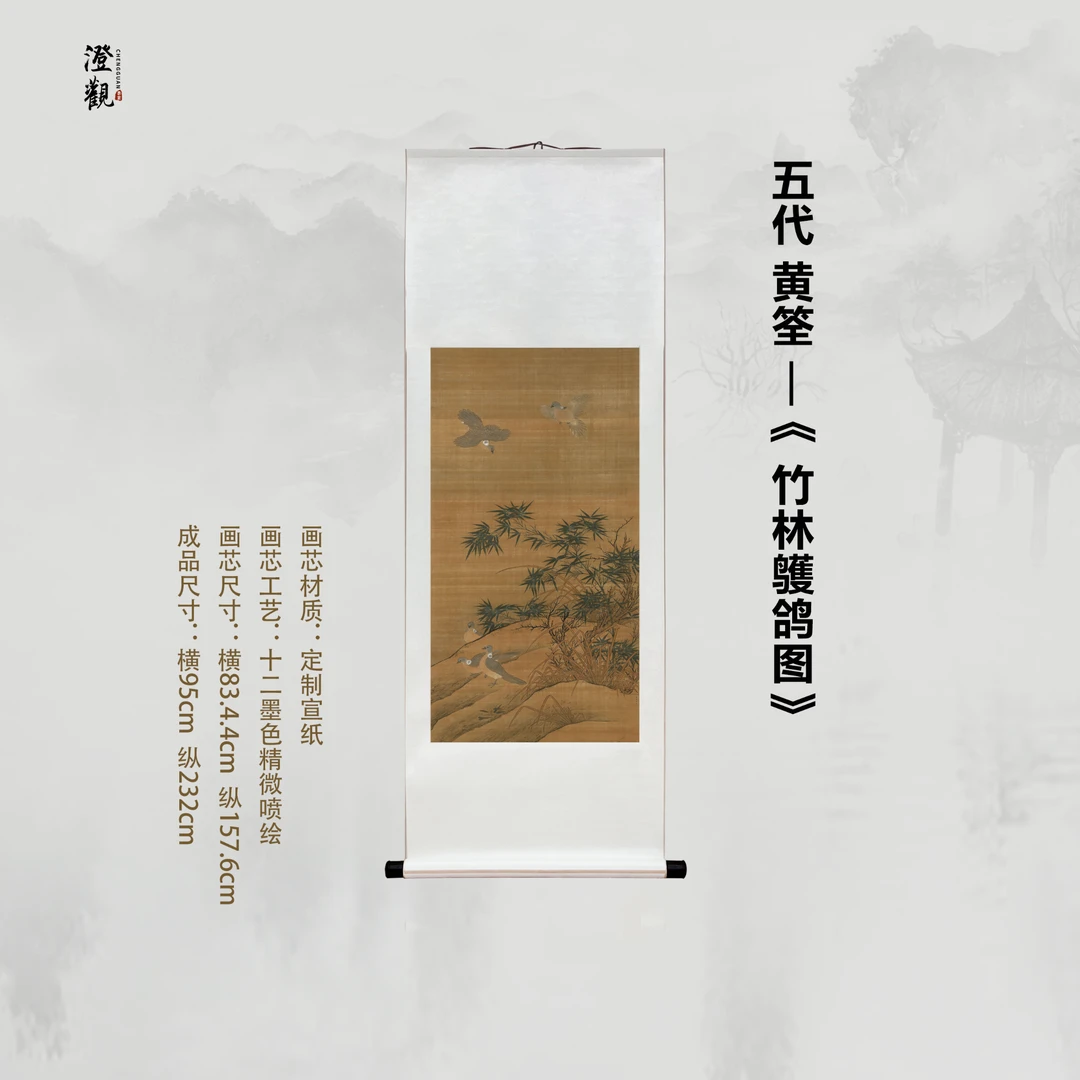
From a stylistic dimension, the painting showcases the Gongbi (工笔) technique at its historical zenith. Huang Quan utilized extremely fine, delicate outlines (leigang) filled with rich, layered mineral pigments. Unlike the "sketching ideas" (xieyi) of later scholars, this work emphasizes objective realism and physical accuracy, capturing the anatomical precision of the turtledoves and the structural integrity of the bamboo leaves with lifelike vitality.
In terms of composition and symbolism, the painting arranges the turtledoves amidst a lush thicket of bamboo and wild shrubs. In Chinese culture, turtledoves symbolize longevity and peace, while bamboo represents integrity and resilience. The density of the foliage creates a sense of a "hidden paradise," reflecting the courtly aesthetic of the era—opulent, serene, and meticulously ordered. The interaction between the birds adds a narrative layer of natural harmony.
The historical significance of "Bamboos and Turtledoves" cannot be overstated. It represents the transition from the Tang Dynasty's grandeur to the Song Dynasty's refined naturalism. Huang Quan’s method of "coloring after sketching" influenced the Northern Song Imperial Painting Academy so profoundly that it became the "official" style, contrasting with the more rugged "Xu Xi" style. This painting is not merely a depiction of nature; it is a cultural artifact that defines the peak of aristocratic taste in 10th-century China.
Today, as we view this work, the preservation of color and the fluidity of the brushwork remain breathtaking. It serves as a primary reference for studying ancient ornithology and botanical illustration in Asia. For collectors and scholars, it remains a "gold standard" for the Flower-and-Bird genre, embodying the eternal pursuit of capturing the "spirit resonance" (qiyun) through disciplined form.