
Zheng Banqiao (郑板桥), one of the most celebrated figures of the Eight Eccentrics of Yangzhou, redefined the boundaries of literati painting during the Qing Dynasty. His work, Bamboo, Rock, and Orchids (竹石幽兰图), serves as a visual manifesto of his personal philosophy, merging poetry, calligraphy, and painting into what is known as the "Triple Perfection" (三绝).
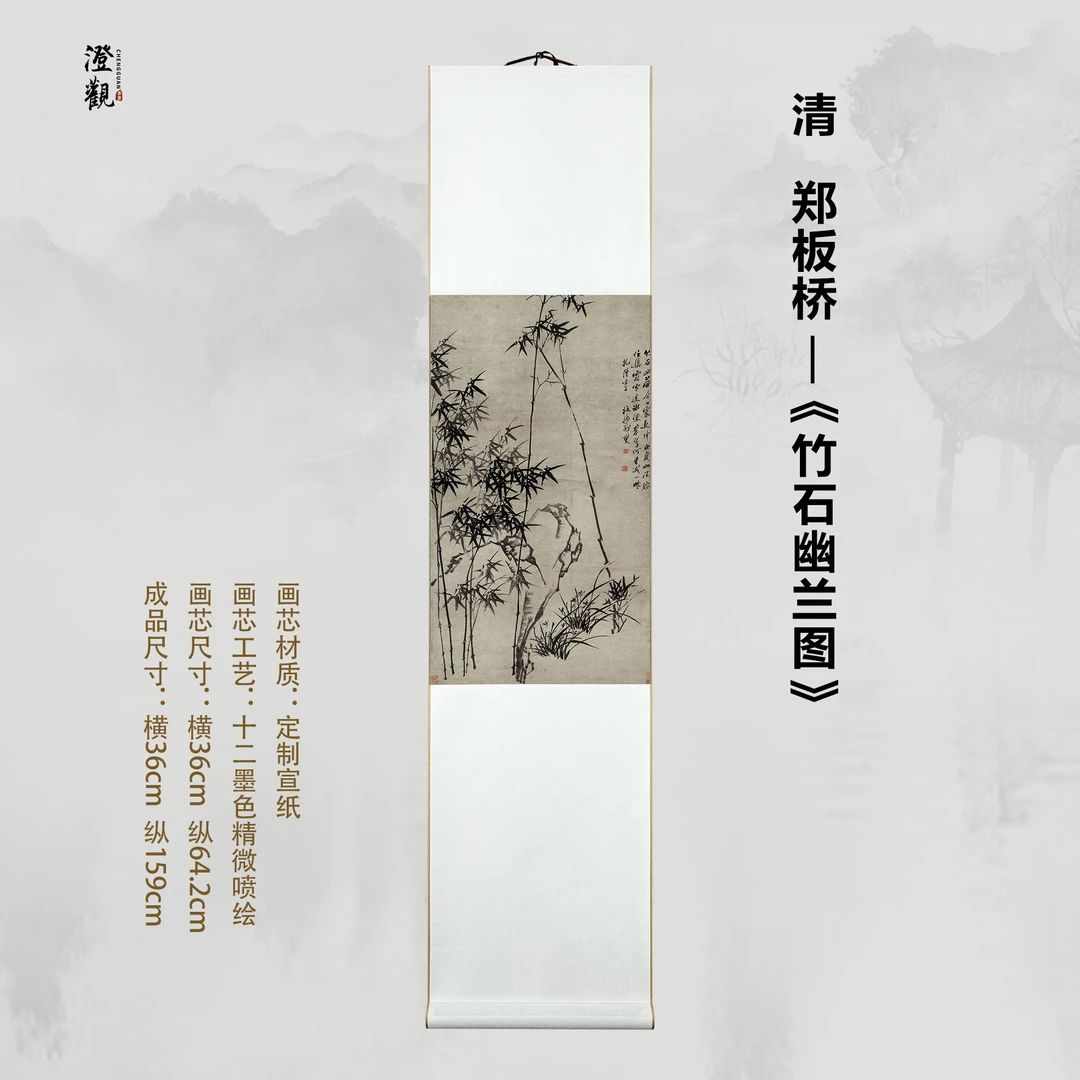
In this composition, the three elements—bamboo, rock, and orchids—are not merely decorative subjects but symbolic archetypes of the scholar's soul. The bamboo represents integrity and resilience, bending but never breaking; the rock stands for permanence and unyielding strength; and the orchids, growing in secluded valleys, symbolize noble solitude and purity. Together, they form a "pure gathering" of nature’s most virtuous forms.
The brushwork in this masterpiece is a direct extension of Zheng’s unique calligraphic style, known as the "Six-and-a-Half Script" (六分半书). Zheng applied the slanted strokes and structural logic of his calligraphy to the painting of bamboo leaves and orchid petals. Each leaf is rendered with decisive, swift movements, creating a sense of rhythmic vitality (Qi Yun). The tonal variations of ink—ranging from "charcoal black" to "ethereal gray"—provide a sense of three-dimensional depth without the need for color.
Zheng Banqiao’s treatment of the rock is particularly innovative. He utilized dry-brush techniques (Fei Bai) to capture the weathered texture and ruggedness of the stone, contrasting it with the saturated ink of the bamboo. This textural contrast emphasizes the harsh environment in which the bamboo and orchids thrive, further highlighting the moral fortitude of the subjects. The minimalist composition leaves significant negative space (Liu Bai), suggesting a vast, untamed wilderness and inviting the viewer into a state of contemplation.
Ultimately, Bamboo, Rock, and Orchids is more than a nature scene; it is a social commentary. Through his inscriptions and visual metaphors, Zheng expressed his empathy for the common people and his defiance against a corrupt bureaucracy. Today, this work remains a canonical masterpiece, admired by collectors and scholars for its intellectual depth and its portrayal of an unbreakable spirit that continues to inspire modern ink-wash art.