
Zhou Fang (active late 8th to early 9th century) was a preeminent figure painter of the Tang Dynasty. Renowned for his depictions of court ladies (shinnü), his style became the gold standard for feminine beauty during the High Tang period. Zhou Fang was famous for capturing the "plump and opulent" aesthetic that was fashionable in the imperial court, moving beyond mere physical likeness to portray the inner world and psychological depth of his subjects.
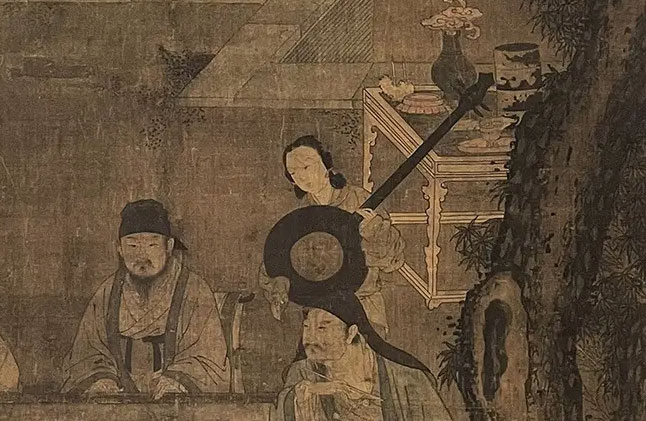
"Musical Performance" (Yan Yue Tu) depicts an intimate and elegant gathering of court ladies engaged in a musical ensemble. The painting offers a rare window into the leisurely lifestyle of the Tang aristocracy. Each figure is positioned with grace, some focused on playing traditional instruments like the Pipa (lute), Zheng (zither), and Sheng (mouth organ), while others listen in a state of contemplative stillness.
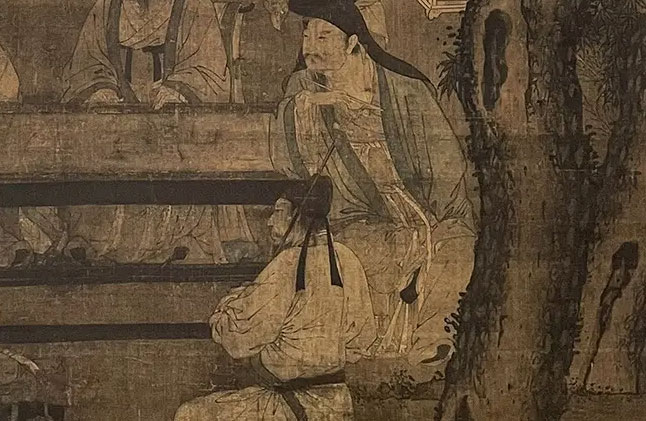
The painting is a quintessential example of the Gongbi (meticulous) style. Zhou Fang employed the "iron-wire line" technique—lines that are thin, firm, and uniform—to delineate the intricate folds of the ladies' silk robes and their delicate features. The use of heavy mineral pigments creates a rich, saturated palette of vermillion, malachite green, and azurite blue, which has retained its vibrancy over centuries. The negative space in the background focuses the viewer's attention entirely on the rhythmic arrangement of the figures.
The instruments depicted in "Musical Performance" reflect the cosmopolitan nature of the Tang Dynasty. Many of these instruments reached China via the Silk Road, illustrating the era's cultural openness and love for foreign melodies. Furthermore, the ladies' lavish hairstyles and floral makeup (huadian) serve as vital historical records of 8th-century fashion and social status within the imperial hierarchy.
In Chinese philosophy, music (Yue) is seen as a reflection of universal harmony. Zhou Fang’s painting is not just a portrait of musicians; it is a visual metaphor for a prosperous and stable society. The dignified expressions and refined postures of the women symbolize moral cultivation and the aesthetic sophistication of the Tang civilization. It remains an enduring icon of classical Chinese beauty.