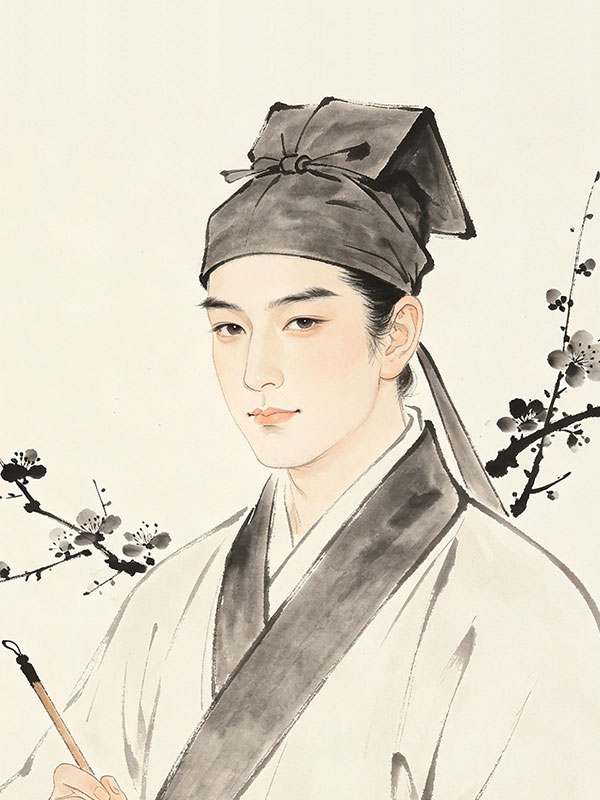
Wang Zhenpeng (王振鹏): The Master of Precision and Yuan Court Painting
Wang Zhenpeng (active c. 1280–1329), courtesy name Pengmei (朋梅) and pseudonym Guyun Chushi (孤云处士), was the most celebrated court painter of the middle Yuan Dynasty. A native of Wenzhou, Zhejiang, he achieved unprecedented fame for his technical virtuosity and was a personal favorite of Emperor Renzong (Ayurbarwada), who bestowed upon him his unique pseudonym.
1. The Supreme Master of Jiehua (Boundary Painting)
Wang Zhenpeng is historically regarded as the greatest practitioner of Jiehua (界画), or "boundary painting," during the Yuan era. This specialized genre involved the use of rulers and compasses to depict complex architectural structures with mathematical precision. While many literati painters moved toward abstract landscapes, Wang perfected the architectural detail of palaces, bridges, and ships, imbuing them with a sense of structural realism and grandeur that remains unsurpassed.
2. Imperial Patronage and Court Life
His career was closely tied to the Mongol imperial court. Emperor Renzong deeply admired Wang’s meticulous skill and often commissioned him to document imperial festivities and grand architectural projects. Because of his imperial favor, Wang had access to the vast palace collections, allowing him to study and refine the styles of previous dynasties, particularly the Northern Song tradition of precision and scale.
3. Mastery of the Baimiao (White Drawing) Technique
Beyond architecture, Wang was a master of Baimiao (白描), a technique of fine-line drawing without color or heavy washes. Influenced by the Song master Li Gonglin, Wang’s figure paintings are characterized by:
- Iron-wire lines: Extremely thin, consistent, and fluid brushstrokes that define form with minimalist elegance.
- Psychological Depth: His depictions of scholars and deities, such as in his Vimalakirti paintings, convey a profound sense of inner serenity and intellectual gravity.
- Clarity and Purity: By eschewing bright colors, he emphasized the rhythmic beauty of the ink line itself.
4. Iconic Masterpieces
Several of Wang Zhenpeng’s works are considered treasures of Chinese art history:
- "Dragon Boat Festival on the Dragon Lake" (Longzhou Tu): This masterpiece showcases his Jiehua skills, depicting ornate imperial dragon boats and teeming crowds with breathtaking detail.
- "Boya Playing the Qin": A classic Baimiao figure painting that captures the legendary musician and his listener, representing the spiritual bond between kindred spirits (Zhiyin).
- "Mahaprajapati Nursing the Infant Buddha": A rare and tender depiction of a Buddhist subject, showcasing his ability to handle delicate drapery and human emotion.
5. Historical Legacy and Influence
Wang Zhenpeng occupied a unique space in the Yuan Dynasty, serving as a bridge between professional court craftsmanship and literati aesthetic values. While the "Four Masters of the Yuan" pushed toward subjective expression, Wang preserved the classical rigor of Chinese representational art. His influence extended to later Ming and Qing court painters, who looked to him as the gold standard for technical perfection and architectural documentation.
— ALL MASTERPIECES LOADED —