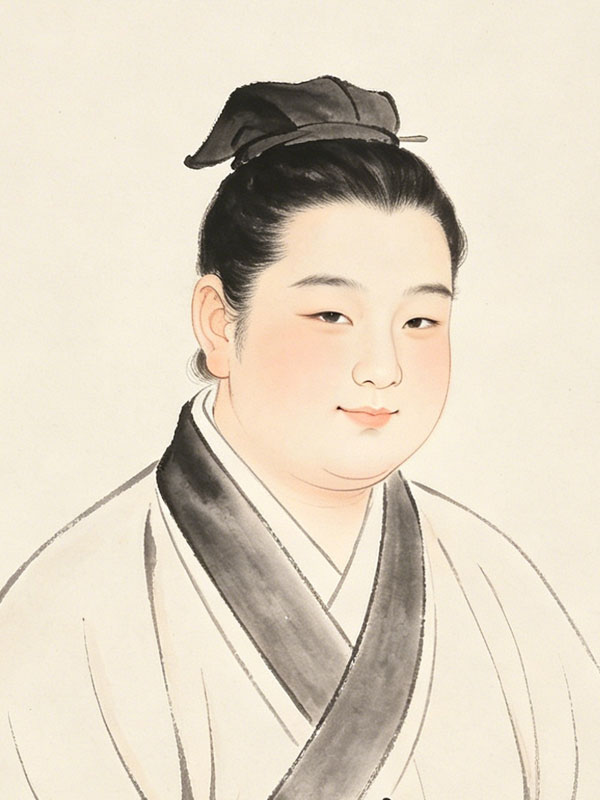
Wang Ximeng: The Prodigy of the Azure Panorama and Song Splendor
Wang Ximeng (1096–1119 AD) was a legendary prodigy of the Northern Song Dynasty, famously mentored by the artist-emperor Huizong himself. Although his life was tragically short—he passed away at the young age of 23—he left behind a single, colossal masterpiece that defined the pinnacle of Chinese landscape painting. His artistic roots were deeply influenced by the Blue and Green Landscape tradition of the Tang and Five Dynasties, which he elevated to an unprecedented level of grandeur and technical complexity.
He is the quintessential master of the Qinglu Shanshui (Blue and Green) style, a technique that had been refined for centuries before reaching its ultimate form through his brush. Unlike the monochromatic ink-wash realism of many of his contemporaries, Wang Ximeng utilized precious mineral pigments, such as azurite blue and malachite green, to create a shimmering, jewel-like brilliance on silk. His brushwork was exceptionally meticulous and fine, combining the spatial logic of Northern Song monumentalism with a vibrant, decorative elegance that symbolized the eternal prosperity of the empire.
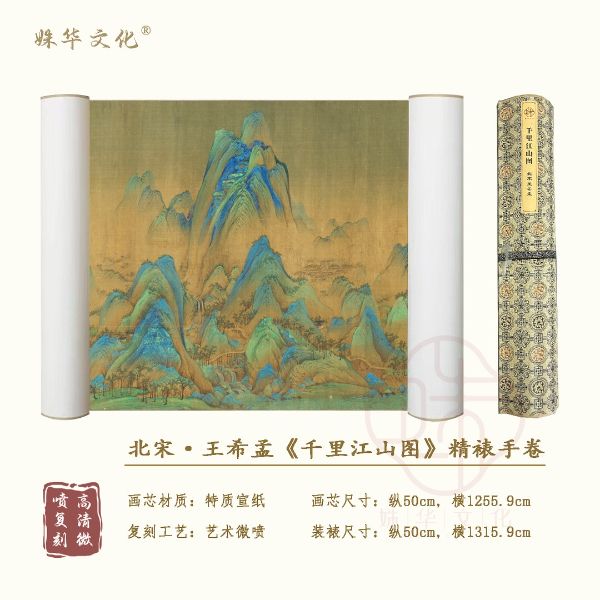
His sole surviving work, "A Thousand Li of Rivers and Mountains" (千里江山图), is widely considered one of the greatest treasures of Chinese art history. Spanning nearly twelve meters in length, this magnificent handscroll depicts a continuous panorama of rolling hills, jagged peaks, and vast waterscapes. The painting is renowned for its intricate detail, featuring tiny fishing boats, pavilions, and bridges that are perfectly integrated into the monumental landscape. It is a symphony of color and form that captures the rhythmic vitality and majestic scale of the Chinese heartland.
Historical records suggest that Wang Ximeng entered the Imperial Painting Academy as a teenager. Recognizing his raw genius, Emperor Huizong personally provided him with specialized instruction and the highest quality materials, including the rarest pigments and finest silk. This imperial patronage allowed the young artist to execute a work of such immense scale and technical difficulty that it would have been nearly impossible for a common painter of the time to achieve. His sudden disappearance from history shortly after completing this work has only added to his mythical status in the art world.
The legacy of Wang Ximeng is defined by his role as the revivalist of color in an age dominated by ink. His work serves as a cultural bridge, preserving the opulent aesthetic of ancient China while looking forward to the refined naturalism of the Song. Today, he is remembered as the "Boy Genius of the Brush," and his masterpiece remains a centerpiece of the Palace Museum in Beijing, representing the golden age of Chinese aesthetics and the transcendental power of youth in creative pursuit.
— ALL MASTERPIECES LOADED —