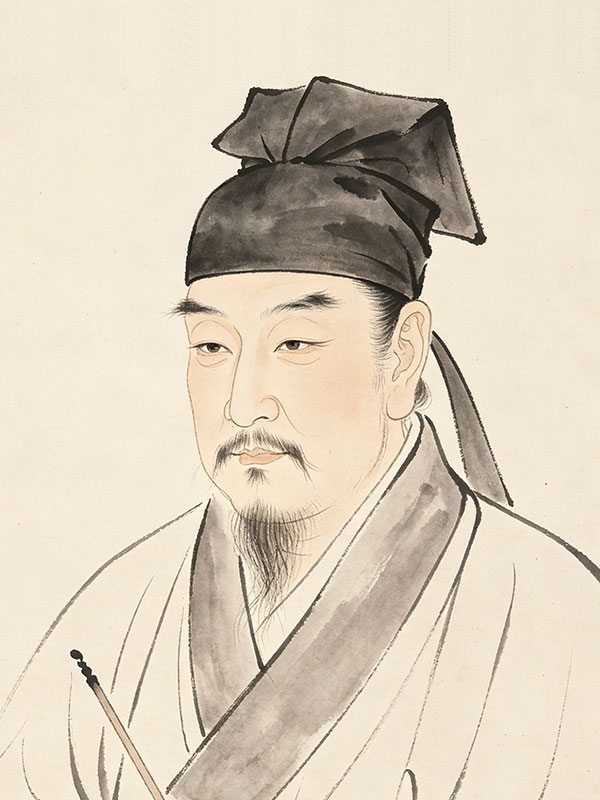
Li Song: The Master of Social Realism and Precision Architecture
Li Song (1166–1243 AD) was a preeminent court painter of the Southern Song Dynasty, serving under three successive emperors: Guangzong, Ningzong, and Lizong. Originally a carpenter from Qiantang (modern-day Hangzhou), his life was transformed when he was adopted and trained by the court painter Li Congxun. This unique background as a craftsman provided him with a profound understanding of structural logic and the hardships of common folk, which became the hallmarks of his highly influential artistic career.
In the history of Chinese art, he is celebrated as a master of Jiehua (ruled-line painting), a specialized technique that utilized mechanical rulers to achieve absolute architectural precision. His depictions of imperial palaces, bridges, and temples were rendered with such mathematical accuracy that they serve as vital historical records of 12th-century engineering. However, unlike many professional academy painters who remained detached from reality, Li Song infused his meticulous brushwork with a deep sense of social empathy and narrative life.
His most famous series, "The Knick-knack Peddler" (Huo Lang Tu), remains a masterpiece of genre painting in Chinese history. Currently held in the Palace Museum and the National Palace Museum, these paintings depict itinerant merchants carrying overloaded racks of goods to villagers. The hundreds of tiny objects—from toys and tools to food—are painted with breathtaking detail, while the joyful and chaotic expressions of the children and mothers capture the vibrant pulse of Song Dynasty grassroots society.
Beyond secular life, Li Song was a pioneer of symbolic and philosophical themes, exemplified by his enigmatic work "Skeleton Fantasy" (Kulou Huanxi Tu). This controversial painting, featuring a large marionette skeleton performing for children, is a rare example of macabre surrealism in traditional Chinese art. It reflects a sophisticated Taoist and Buddhist meditation on the illusion of life and the inevitability of death, showcasing his ability to blend technical realism with profound intellectual inquiry.
The legacy of Li Song is defined by his role as the premier chronicler of both the imperial splendor and the daily struggles of the Southern Song. He was awarded the Golden Belt by the court, yet he never lost his connection to his humble roots. Today, his works are considered national treasures, providing a rare and honest window into the material culture and spiritual landscape of medieval China. His influence on later professional and folk artists ensured that the tradition of observational realism remained a vital force in the centuries to follow.
— ALL MASTERPIECES LOADED —