
Jing Hao: The Founding Father of the Northern Landscape School
Jing Hao (c. 850–911 AD), courtesy name Haoran, was a revolutionary landscape painter and influential art theorist of the late Tang Dynasty and the Five Dynasties period. Born in Qinshui (modern-day Shanxi), he witnessed the chaotic collapse of the Tang Empire and chose to live as a hermit in the Taihang Mountains. Residing in the secluded Honggu Valley (Great Cliff Valley), he adopted the sobriquet Honggu Zi. This period of reclusion allowed him to immerse himself in the monumental scale of northern China's geography, fundamentally shifting the course of Chinese art history.
He is historically revered as the founding patriarch of the Northern Landscape School. Before Jing Hao, landscape painting was often decorative or served as a backdrop for figures. He transformed it into an independent genre characterized by grandeur and austerity. His style successfully integrated the vigorous brushwork of the Tang masters with a sophisticated use of ink wash, creating a sense of volumetric mass and atmospheric depth that had never been achieved before. His depictions of towering peaks, craggy cliffs, and resilient pine trees became the canonical imagery of the Chinese wilderness.
Beyond his brushwork, Jing Hao was a profound thinker who authored "Bifa Ji" (Notes on Brush Method), one of the most important treatises on painting in Chinese history. In this work, he proposed the "Six Essentials" (Liu Yao): Spirit (Qi), Resonance (Yun), Thought (Si), Scene (Jing), Brush (Bi), and Ink (Mo). Most significantly, he made a crucial distinction between "Likeness" (Hua)—mere external resemblance—and "Truth" (Zhen), which represents the inner essence and vital energy of the subject. This theoretical framework elevated painting from a craft to a spiritual and intellectual pursuit.
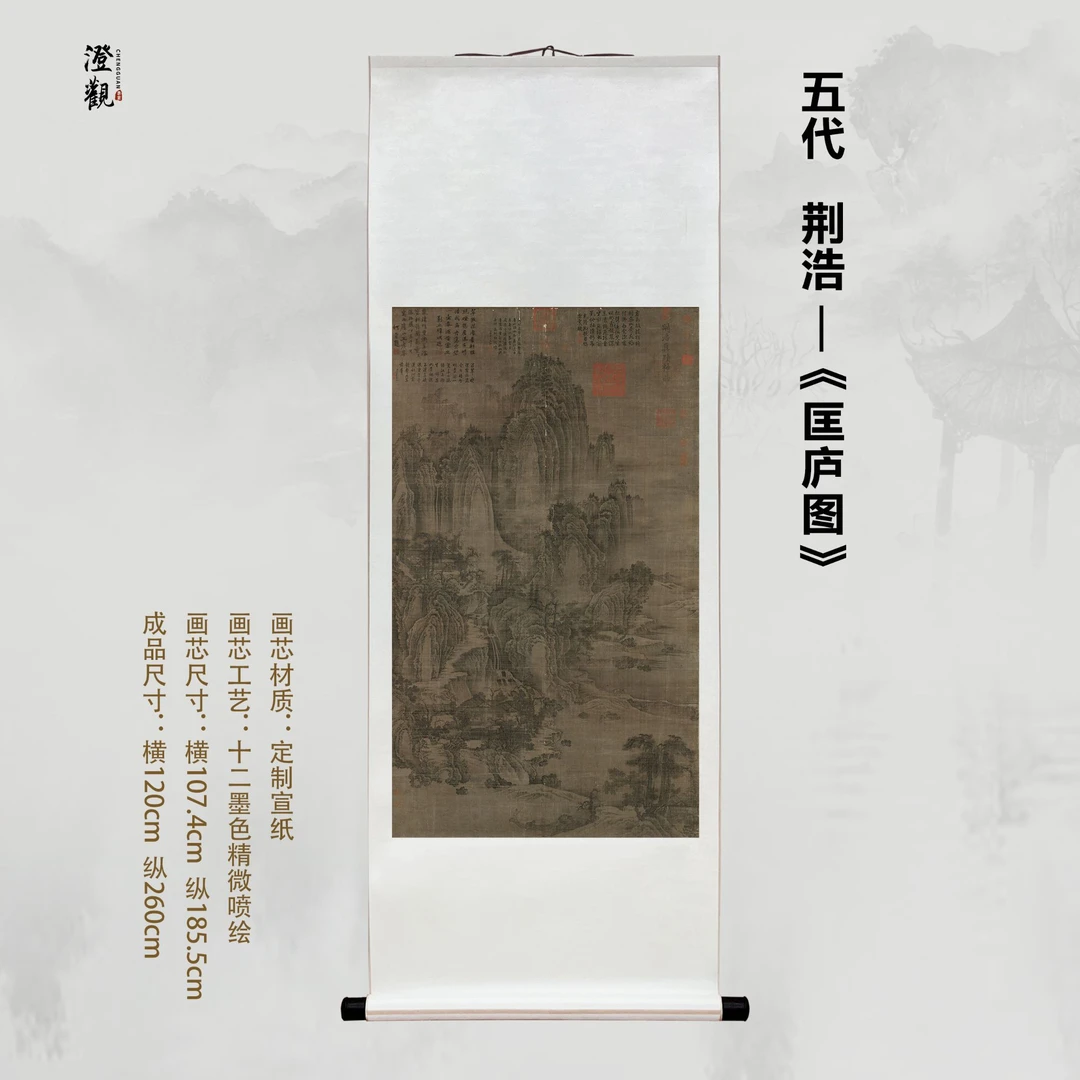
His most famous masterpiece, "Mount Kuanglu" (匡庐图), currently housed in the National Palace Museum, epitomizes the "monumental landscape" style. The painting utilizes a "high distance" (Gao Yuan) perspective, where a massive central peak dominates the composition, surrounded by deep ravines and winding paths. The meticulous texture strokes (Cunfa) used to render the rocky surfaces and the layered ink washes to suggest mist and light demonstrate his mastery over spatial logic. This work served as the primary visual blueprint for later Song Dynasty giants like Fan Kuan and Guo Xi.
The legacy of Jing Hao is immeasurable, as he bridged the transition from the coloristic traditions of the Sui and Tang to the ink-centered realism of the Song. His direct disciple, Guan Tong, further refined his techniques, and together they are remembered as the pioneers of the Northern tradition. Today, Jing Hao is honored not just as a painter of mountains, but as the philosopher-artist who taught future generations how to capture the soul of the earth through the "truth" of ink and silk.
— ALL MASTERPIECES LOADED —