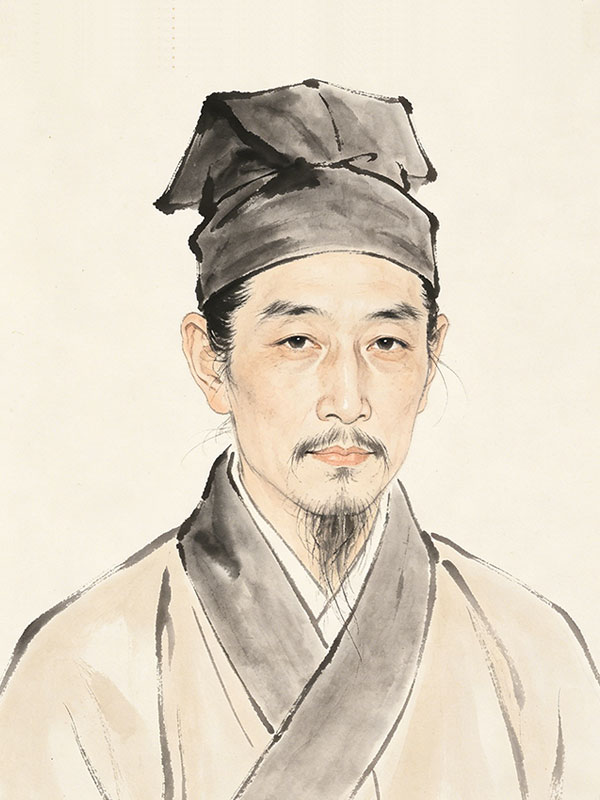
Jiang Shen: The Guardian of the Misty Southern Landscape Tradition
Jiang Shen (active late 11th to early 12th century), courtesy name Guandao and sobriquet Juyang Laoren, was a preeminent landscape painter of the late Northern Song and early Southern Song Dynasty. A native of Quzhou (modern-day Zhejiang), he was a reclusive scholar-artist who lived through the traumatic transition of the Song court to the south. Although he served briefly as a painter-in-attendance in the Imperial Academy, his soul remained in the wild, misty hills of the Jiangnan region, where he spent most of his life as a hermit and wanderer.
He is historically revered as the most significant successor to the Dong-Ju School (founded by Dong Yuan and Juran) during the Song Dynasty. At a time when many court painters were focused on the jagged, "axe-cut" realism of the north, Jiang Shen remained a steadfast defender of the Southern Landscape School (Nan Zong). His work captured the moist, humid atmosphere and the rolling, earthen hills of southern China, emphasizing "naturalness and plainness" (Pingdan Tianzhen) over formal decorative beauty.
Technically, Jiang Shen was a master of moist ink washes and dense textural layering. He perfected the "hemp-fiber stroke" (Pima Cun), using long, fluid lines to describe the soft surfaces of mountains. He was also famous for his use of "alum lumps" (Fantou) and "scattered dots" (Jiaodian) to represent the lush vegetation of the southern climate. His brushwork was described as "vigorous yet blurred," creating a shimmering effect where mountains seem to emerge and dissolve within the shifting mists and deep shadows of the riverbanks.
His undisputed masterpiece, "Verdant Mountains" (also known as Thousands of Cliffs and Ten Thousand Valleys or Qianyan Wanchui Tu), currently held in the National Palace Museum, is a pinnacle of the handscroll tradition. Spanning nearly seven meters, the painting is a symphony of ink, leading the viewer through a dense, rhythmic journey of secluded forests, winding streams, and towering peaks. The work is celebrated for its tonal richness and its ability to convey a sense of unbound vastness and spiritual serenity through the simple medium of ink on silk.
The historical records suggest that Jiang Shen was a man of great integrity who was highly respected by the literati of his time, including the calligrapher Zhao Mengfu of later generations who praised his "ancient spirit." Despite his immense talent, he reportedly died of exhaustion just as he was about to be summoned for a high-level imperial audience. Today, he is remembered as the artist who preserved the soul of the south, bridging the gap between the 10th-century pioneers and the Yuan Dynasty masters who would later elevate his ink-centered philosophy to the height of scholarly art.
— ALL MASTERPIECES LOADED —