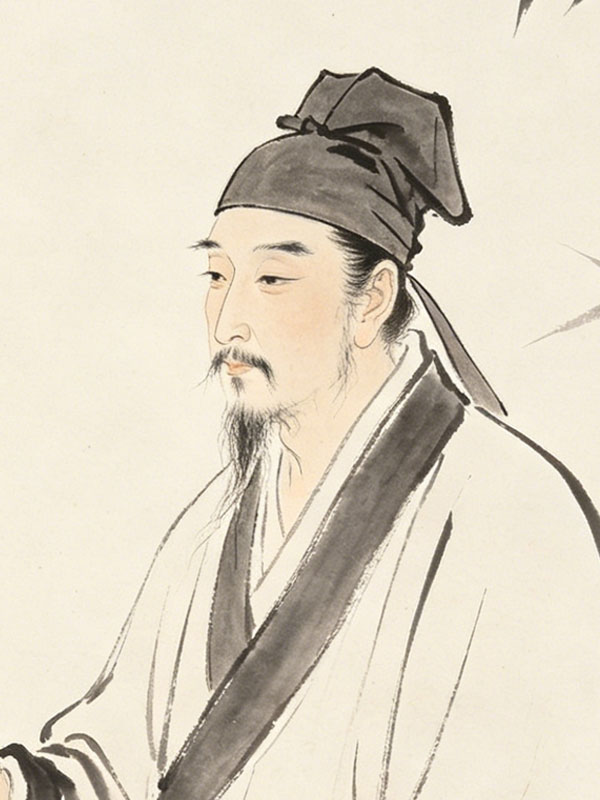
Huang Jucai: The Standard-Bearer of the Imperial Academic Style
Huang Jucai (933–993 AD), courtesy name Bolan, was a preeminent court painter whose career bridged the transition from the Later Shu kingdom of the Five Dynasties to the early Northern Song Dynasty. As the youngest son of the legendary Huang Quan, he was the primary heir to the "Huang Style," which dominated Chinese flower-and-bird painting for over a century. Following the fall of the Later Shu, he accompanied his father to the new Song capital of Kaifeng, where he became a favored artist of Emperor Taizu and Emperor Taizong, eventually reaching the highest rank in the Imperial Painting Academy.
He is historically celebrated as the most faithful practitioner of the "Huang’s Wealth" (Huang Jia Fu Gui) aesthetic. This style was characterized by opulence, formal elegance, and a level of meticulous realism (Gongbi) that was perfectly suited for the imperial palaces. Huang Jucai refined his father’s techniques, focusing on exotic birds, rare flowers, and rugged rocks. His brushwork was fine and firm, utilizing the "outline-and-fill" method (Goule Tiancai) to create vibrant, jewel-like images that symbolized the stability and splendor of the early Song Empire.
Technically, Huang Jucai was a master of color and structural precision. He utilized mineral pigments—such as malachite green and azurite blue—layered over subtle ink washes to achieve a three-dimensional effect. His birds were rendered with scientific accuracy, capturing the tactile texture of feathers and the glint of life in their eyes. Unlike the "wild" and ink-wash styles of the southern painters, his work maintained a polished, academic finish that became the official orthodox standard for the Song Painting Academy for nearly a hundred years.
His undisputed masterpiece, "Pheasant and Small Birds by a Jujube Shrub" (山鹧棘雀图), currently held in the National Palace Museum, is a definitive example of early Song naturalistic realism. The painting depicts a pheasant perched on a rock amidst thorny shrubs and small birds, arranged in a monumental vertical composition. Every leaf, thorn, and feather is rendered with surgical precision, yet the work maintains a sense of rhythmic vitality (Qi Yun) and tranquil dignity. This work was highly praised in the "Xuanhe Catalogue of Paintings" and served as a canonical textbook for generations of academy students.
The legacy of Huang Jucai lies in his role as the architect of the academic canon. By successfully transplanting the artistic traditions of the Later Shu court to the Northern Song, he ensured the survival of the high-realistic style during a period of political upheaval. His influence was so great that it was not until the arrival of Cui Bai in the mid-11th century that his "perfected" style was finally challenged. Today, Huang Jucai is remembered as the artist who defined the imperial gaze, representing the pinnacle of sophisticated craftsmanship and the aristocratic spirit of 10th-century Chinese art.
— ALL MASTERPIECES LOADED —