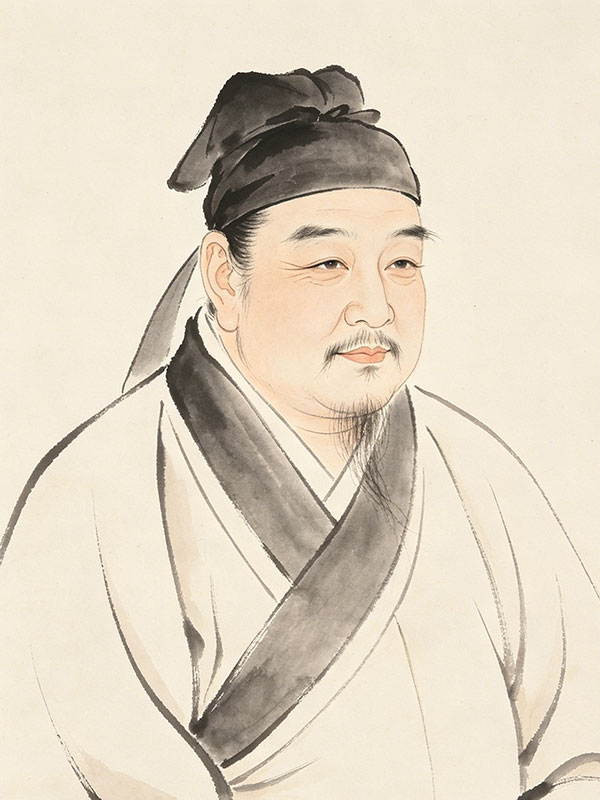
Guo Si: The Scholar-Official and Steward of the Monumental Tradition
Guo Si (active late 11th to early 12th century), courtesy name Desu, was a prominent scholar-official and painter of the Northern Song Dynasty. As the son of the legendary landscape master Guo Xi, he was born into the heart of the imperial artistic circle. Unlike his father, who was primarily a court professional, Guo Si held high-ranking civil positions, eventually serving as a Scholar of the Longtu Pavilion. His dual identity as a high-level bureaucrat and an artist allowed him to advocate for the intellectual status of landscape painting within the imperial court.
He is historically immortalized for his monumental contribution to art theory. He meticulously compiled and edited his father's oral teachings and philosophical insights into the seminal treatise "Linquan Gaozhi" (Lofty Record of Forests and Springs). This work is arguably the most influential theoretical text in the history of Chinese landscape painting. Through this publication, Guo Si codified the revolutionary concept of the "Three Distances" (San Yuan)—High, Deep, and Level distance—providing a systematic framework for spatial composition that remains a cornerstone of Chinese aesthetics to this day.
As a practitioner, Guo Si was a faithful heir to the Li-Guo School, a stylistic lineage founded by Li Cheng and perfected by his father. His own paintings are characterized by the same "Curling Cloud" texture strokes (Juanyun Cun) and "Crab-claw" branches (Xiezhua) that defined the monumental style. He was particularly skilled at depicting wintry forests, rugged peaks, and secluded mountain paths. His brushwork was described as vigorous and refined, successfully capturing the rhythmic vitality and atmospheric depth typical of the Northern Song wilderness.
Historical records, such as the Xuanhe Catalogue of Paintings, highlight his versatility beyond landscapes, noting his skill in painting horses, figures, and architectural settings. However, his primary legacy remains his role as a cultural bridge. By documenting his father’s creative process and landscape philosophy, he ensured that the 11th-century peak of naturalistic realism survived the political upheavals of the Song transition. He transformed his father's individual genius into an educational canon that influenced generations of artists, from the academic painters of the Southern Song to the literati masters of the Yuan and Ming dynasties.
Today, Guo Si is remembered as the artist-philosopher who gave a literary voice to the silent mountains of China. His efforts ensured that the spiritual pursuit of "wandering through forests and springs" became a permanent aspiration for the Chinese intellectual class. His surviving works and his theoretical legacy, housed in institutions like the Palace Museum, continue to be studied as the definitive guide to understanding the monumental landscape tradition and the sophisticated connoisseurship of the Northern Song elite.
— ALL MASTERPIECES LOADED —