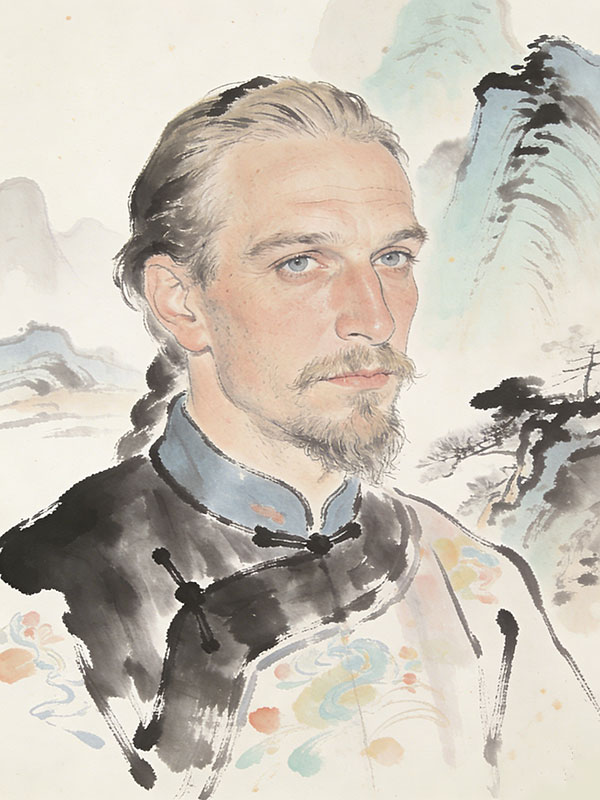
Giuseppe Castiglione (Lang Shining / 郎世宁): The Jesuit Master of the Qing Court
Giuseppe Castiglione (1688–1766), known in China by his adopted name Lang Shining (郎世宁), was an Italian Jesuit missionary and a legendary court painter who served during the reigns of the Kangxi, Yongzheng, and Qianlong emperors. He is arguably the most influential foreign artist in Chinese history, credited with creating a unique synthesis of European and Chinese painting styles that defined the "New Court Style" (Xin Tizhi) of the 18th century.
1. A Lifelong Service in the Forbidden City
Born in Milan, Castiglione arrived in China in 1715. Unlike most missionaries who focused on religious conversion, Castiglione’s primary contribution was his artistic genius. He lived within the Forbidden City for over 50 years, becoming a favorite of the Qianlong Emperor. His high status allowed him to work closely with the Imperial Painting Academy, where he trained numerous Chinese artists in Western techniques, effectively bridging the gap between two vastly different artistic worlds.
2. The Fusion of Artistic Traditions
Lang Shining’s revolutionary style combined Western realism with Chinese aesthetic sensibilities. His technical innovations included:
- Linear Perspective: He introduced the concept of vanishing points to create a realistic sense of spatial depth, a technique largely absent from traditional "shifting" Chinese perspectives.
- Chiaroscuro (Light and Shadow): He used subtle shading and modeling to give his subjects a three-dimensional, sculptural quality. However, to suit Chinese tastes, he avoided harsh shadows, opting for a softer frontal lighting.
- Traditional Media: Despite his Western training, he mastered the use of silk, ink, and mineral pigments. He adapted his oil painting skills to the demanding and unforgiving nature of Chinese watercolor on silk.
3. Master of Horses and Imperial Portraits
Lang Shining is perhaps most famous for his depictions of horses and the imperial family.
- "One Hundred Horses" (Baizhun Tu): His seven-meter-long masterpiece, "One Hundred Horses," is a definitive example of his skill, showcasing dozens of steeds in various poses within a meticulously rendered landscape that features both Western realism and Chinese poetic atmosphere.
- Imperial Portraiture: He was the principal portraitist for the Qianlong Emperor and his consorts. His portraits, such as "The Emperor Qianlong in Ceremonial Armor on Horseback," were designed to project imperial power and majesty while maintaining a highly lifelike appearance.
4. Architectural Legacy: The Old Summer Palace
Beyond the canvas, Lang Shining was a talented architect. He was a key designer of the Xiyang Lou (Western-style Mansions) within the Yuanmingyuan (Old Summer Palace). These marble palaces combined Baroque and Rococo styles with traditional Chinese motifs. Although the palace was largely destroyed in 1860, the remaining ruins stand as a testament to his cross-cultural architectural vision.
5. Historical Legacy and Global Influence
Lang Shining’s influence was profound, shaping the court aesthetic for generations. He demonstrated that Western empirical observation could coexist with Chinese spiritual resonance. Today, his works are among the most valuable treasures in the Palace Museum (Beijing) and the National Palace Museum (Taipei). His life remains a premier example of cultural diplomacy and the enduring power of artistic exchange between the East and the West.

— ALL MASTERPIECES LOADED —