Bada Shanren (八大山人): The Eccentric Genius of Individualist Painting
Bada Shanren (c. 1626–1705), born Zhu Da (朱耷), was a legendary painter and calligrapher of the early Qing Dynasty. A descendant of the Ming imperial family, his life was defined by the trauma of the Manchu conquest, leading him to a life of reclusion as a Zen Buddhist monk and later a Taoist priest. He is celebrated as the most prominent of the Four Monk Masters (Si Seng) and the father of modern Chinese expressionism.
1. A Life of Mourning and "Madness"
Following the fall of the Ming Dynasty in 1644, Zhu Da fled to a monastery to escape political persecution. To protect himself, he often feigned muteness and madness, communicating only through his art and enigmatic gestures. His pseudonym, Bada Shanren, when written in a vertical cursive style, resembles the Chinese characters for "laugh" (xiao) and "cry" (ku), perfectly encapsulating his bitter irony and grief over his lost heritage.
2. The "Rolling Eyes" of Defiance
Bada Shanren’s most iconic stylistic trait is found in his depictions of animals, particularly birds and fish.
- Upward-Staring Eyes: His subjects are often portrayed with enlarged, upward-looking eyes, a silent gesture of defiance and disdain toward the Qing conquerors.
- Solitary and Aloof: These creatures are typically rendered alone in a vast negative space, embodying the artist's own sense of isolation and spiritual reclusion.
3. Minimalism and the "Power of the Void"
Bada Shanren revolutionized the Xieyi (freehand) style through extreme minimalism. His work is characterized by:
- Abbreviated Brushwork: He achieved maximum expression with a minimum of strokes, using wet, saturated ink to create forms that seem to vibrate with internal energy.
- Negative Space (Liu-bai): He utilized the "void" of the paper as a structural element, making the unpainted areas as significant as the ink itself.
- Dynamic Balance: Despite the sparse nature of his compositions, his works possess an unbreakable structural integrity and rhythmic flow.
4. Landscape Painting: Deconstruction and Rebirth
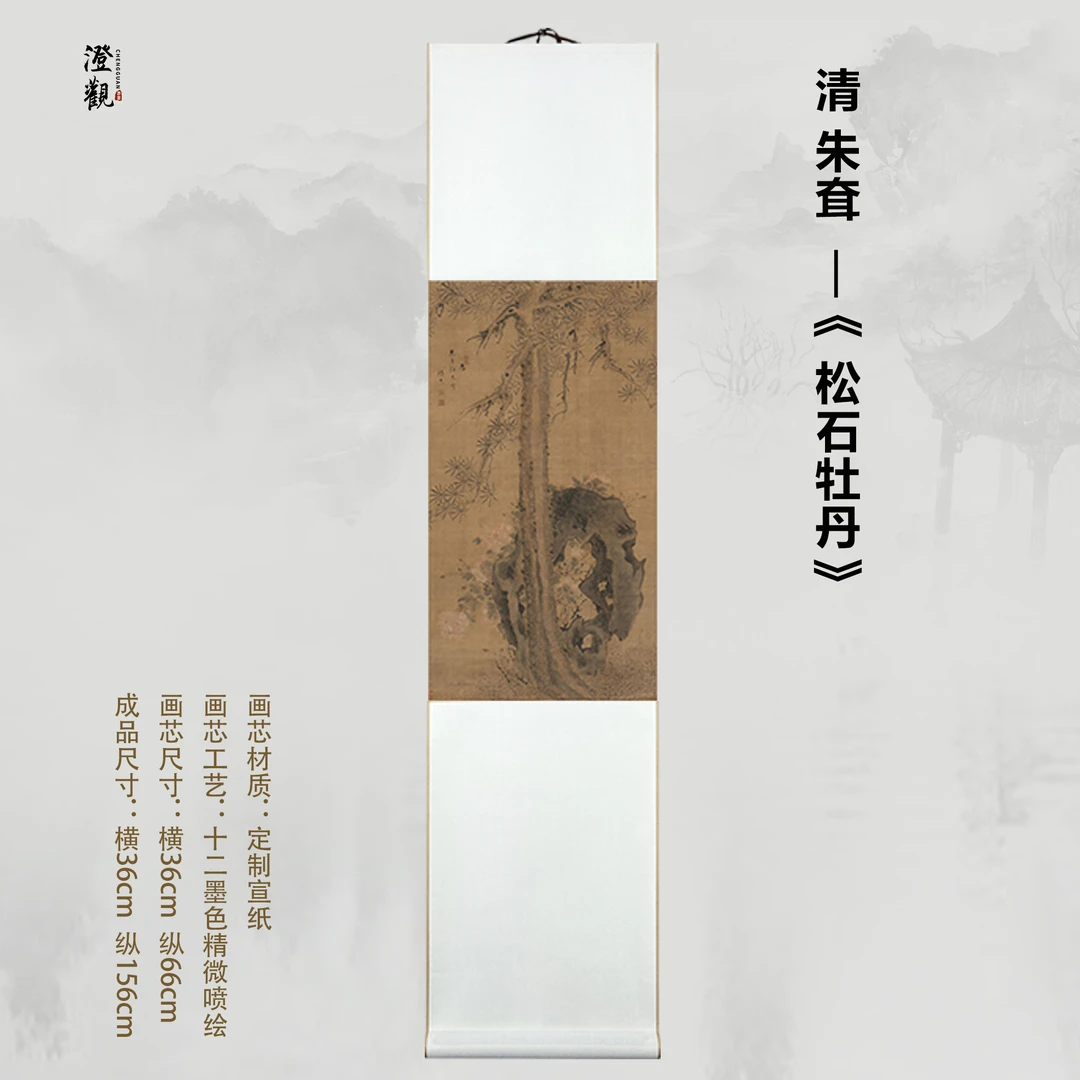
In his landscapes, Bada Shanren broke away from the meticulous "Orthodox" style. Influenced by Dong Qichang but far more radical, he deconstructed mountains and trees into abstract, tilted forms. His landscapes often feel "broken" or unstable, reflecting the fragmented world he inhabited after the dynastic transition. His use of dry brush (kabi) and "rubbing" techniques created textures that felt ancient, raw, and spiritually profound.
5. Historical Legacy and Influence on Modern Art
Bada Shanren’s impact on East Asian art is immeasurable. He was the primary inspiration for the Eight Eccentrics of Yangzhou and later masters like Qi Baishi and Pan Tianshou. In the 20th century, his subjective expressionism and abstract sensibilities were recognized by Western critics as being centuries ahead of their time. Today, his works are among the most expensive and sought-after treasures in the Palace Museum (Beijing), the National Palace Museum (Taipei), and the Freer Gallery of Art (Washington, D.C.).