
Guan Tong: The Architect of Rugged Majesty and Northern Peaks
Guan Tong (active c. 907–960 AD) was a monumental landscape painter of the Five Dynasties period, specifically serving the Later Liang dynasty. A native of Chang'an, he was the primary disciple of the legendary master Jing Hao. He is historically celebrated for not only inheriting his teacher's techniques but also for surpassing them to develop a distinct, highly influential aesthetic known as the "Guan Style" (Guan Jia Shanshui). His life was defined by a deep immersion in nature, as he spent long periods in the mountains to observe their true spirit beyond mere outward appearance.
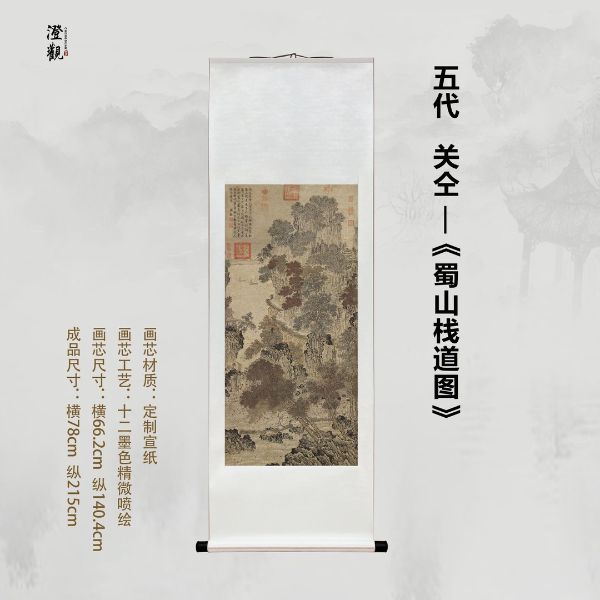
His artistic vision is defined by a sense of rugged grandeur and desolate majesty. While his master focused on the "Six Essentials" of theory, Guan Tong pushed the boundaries of compositional intensity. He is famous for depicting precipitous peaks, steep cliffs, and deep ravines that seem to surge upward with primitive power. His landscapes are often described as "abrupt and steep" (Chun Ya), evoking a solemn, lonely atmosphere that perfectly captures the unyielding character of northern China's geography.
Technically, he was a master of simplification and strength. He moved away from excessive, decorative detail, opting instead for bold, incisive brushwork and dense ink washes to define the skeletal structure of mountains. He used thick, sharp lines to render rocky textures and withered trees, creating a tactile sense of weight and ancient age. This minimalist yet powerful approach allowed him to convey the vastness of space and the permanence of the earth with a remarkable economy of ink, a quality highly prized by later literati.
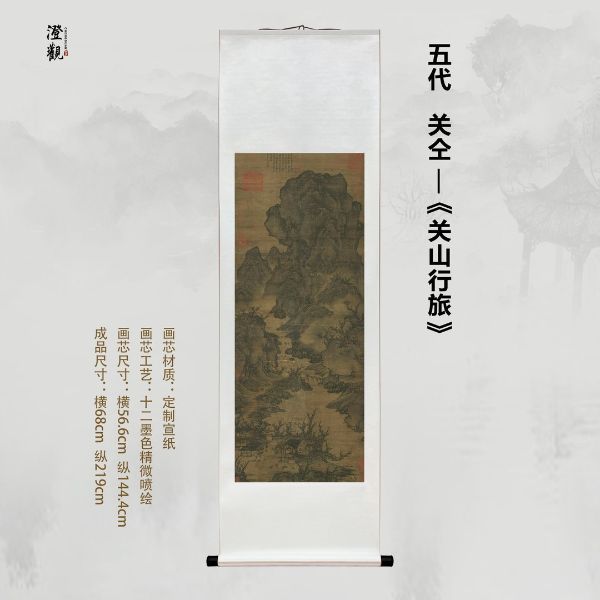
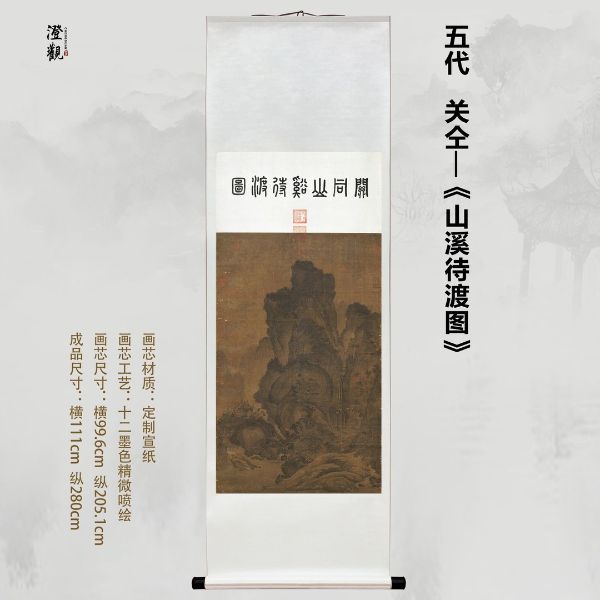
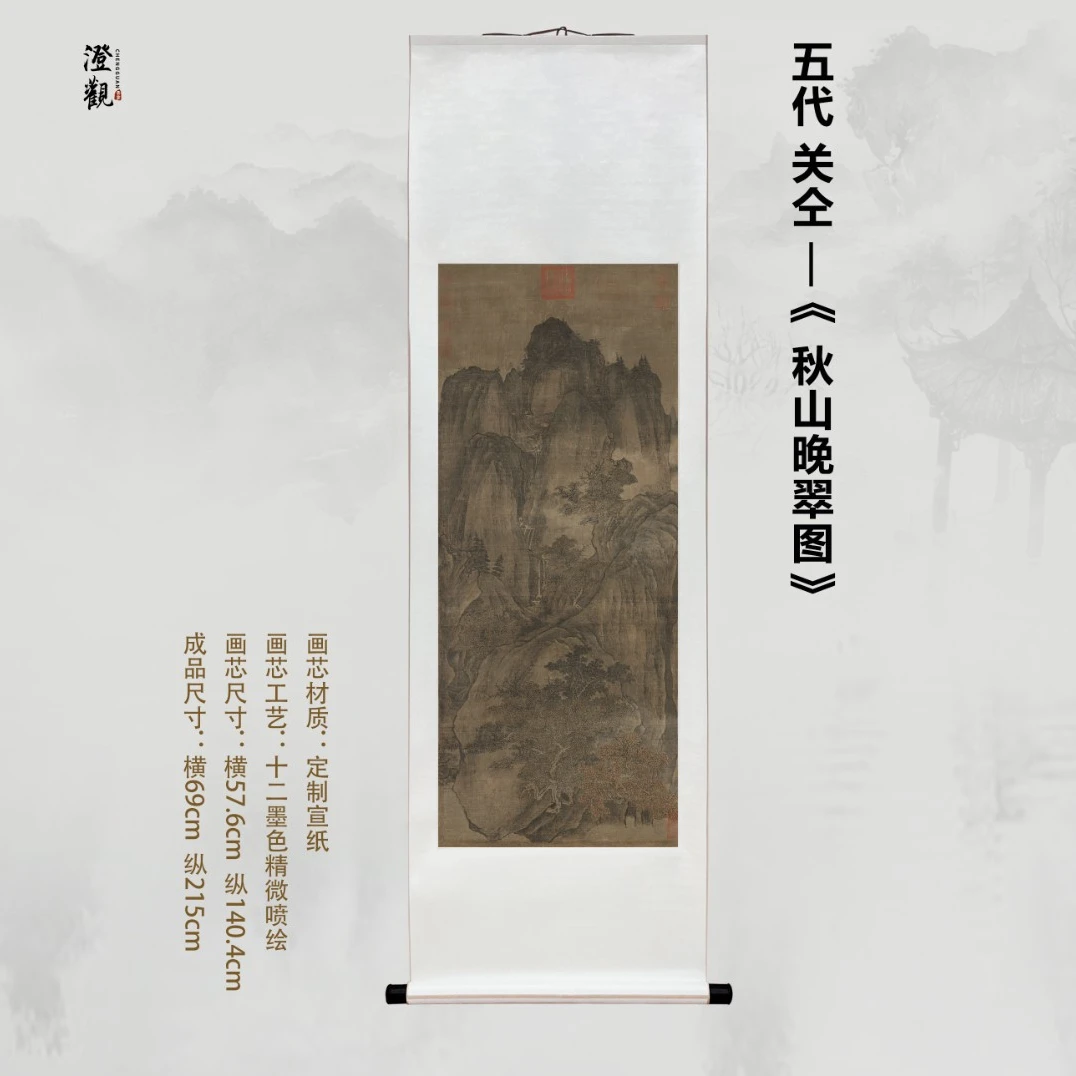
His surviving masterpieces, such as "Waiting for a Ferry" (Guan Shan Xing Lv Tu) and "Autumn Mountain at Twilight" (Qiu Shan Wan Cui Tu), are considered national treasures. In these works, he brilliantly balances monumental scale with intimate human elements, such as humble travelers or secluded temples, which serve to emphasize the overwhelming scale of nature. His ability to render the misty transition between light and shadow on jagged rocks became a standard of excellence for the Imperial Painting Academy in the subsequent Song Dynasty.
The legacy of Guan Tong is reflected in his standing as one of the "Three Masters of Early Landscape" (alongside Li Cheng and Fan Kuan). Historical critics, such as Mi Fu of the Song Dynasty, praised his work for being "lofty and ancient," noting that his paintings possessed a "divine quality" that transcended mere technical skill. Today, his works in the National Palace Museum continue to inspire artists and scholars, representing the pinnacle of the northern tradition and the spiritual depth of early Chinese ink-wash landscape painting.
— ALL MASTERPIECES LOADED —