
In the sacred canon of Chinese landscape painting, the Five Dynasties period (907–960 AD) represents the birth of "Monumental Realism." At the heart of this revolution was Guan Tong, a master who transformed the cold, rugged "bones" of the earth into silk. His crowning achievement, Travelers among Mountains and Passes (关山行旅图), currently held in the National Palace Museum in Taipei, is not merely a depiction of scenery; it is an architectural monument of the soul. It established the definitive aesthetic of the Northern School—a world of unyielding cliffs, desolate magnificence, and a profound, stoic dignity that has influenced global art for over a millennium.
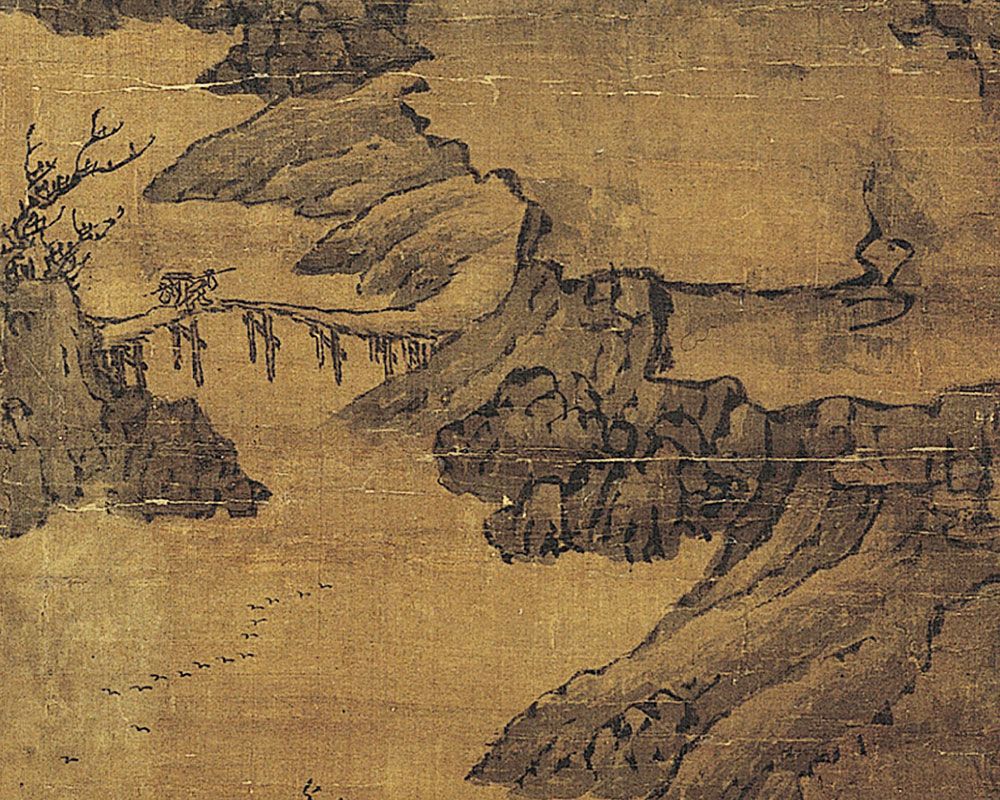
Guan Tong was a man of the North, hailing from Chang'an. He famously sought to reach beyond the foundations of his teacher, Jing Hao, creating a style that art critics described as "simple in stroke but majestic in spirit." Guan Tong believed that art should capture the underlying structure—the "skeletal strength"—of the natural world. In this work, the mountains are "stony," possessing a hardness and weight that suggest the eternal stability of the universe. He is revered as the first of the "Three Great Masters of the Northern Song Landscape," serving as the spiritual and technical ancestor to legends like Li Cheng and Fan Kuan.
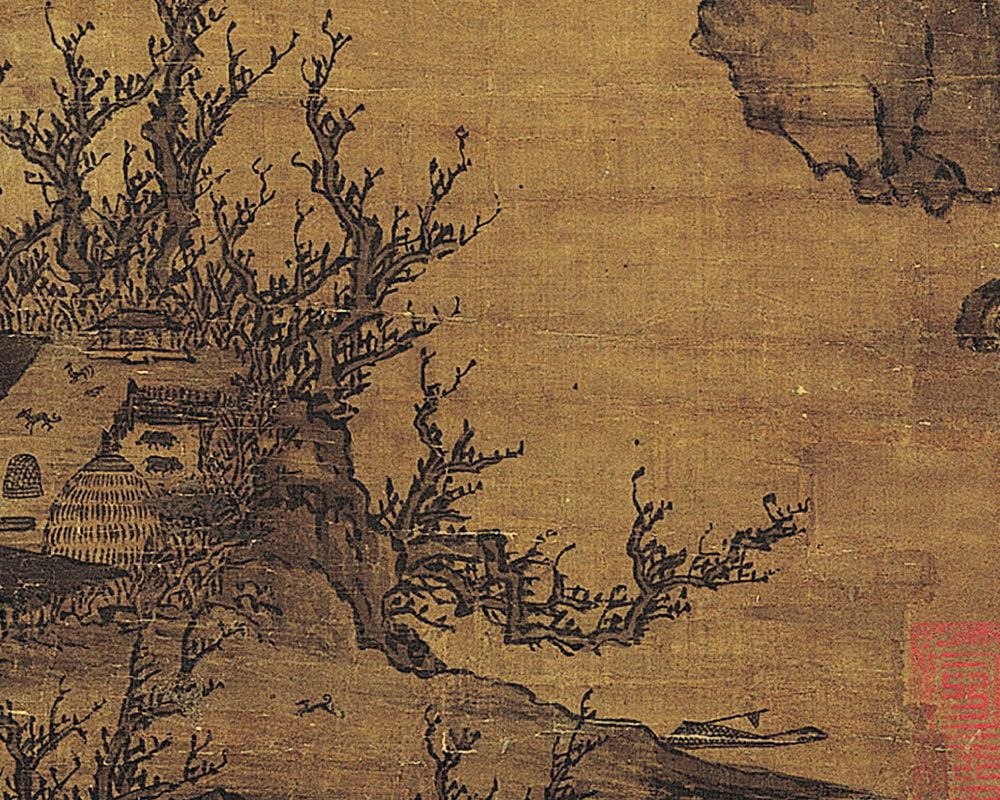
The painting utilizes the classic "High Distance" (Gaoyuan) compositional technique to create an overwhelming sense of verticality and scale. At the base, we see the bustling "Red Dust" of human life—tiny travelers and their pack mules navigating a winding path by a rushing mountain stream. As the eye travels upward through the mist of the middle ground, secluded dwellings and thatched inns emerge from the ravines, illustrating the literati ideal of a world that is "fit for wandering and fit for living." Finally, the gaze is confronted by the monumental central peak, which rises abruptly like a monolith into the clouds, asserting the absolute authority of nature over man.
Technically, the work is a masterclass in Guan Tong’s signature brushwork. He pioneered the "Nail-head" texture stroke (Dingtou Cun)—short, forceful, and sharp marks that mimic the wind-scoured surfaces of granite and limestone cliffs. These strokes are not merely decorative; they are driven into the paper with a rhythmic power that gives the mountain its physical volume. The trees, known as "Pines on Stone," feature branches as tensed and sharp as iron hooks, providing a striking contrast to the atmospheric ink washes that suggest the cold, crisp air of a Northern autumn evening.
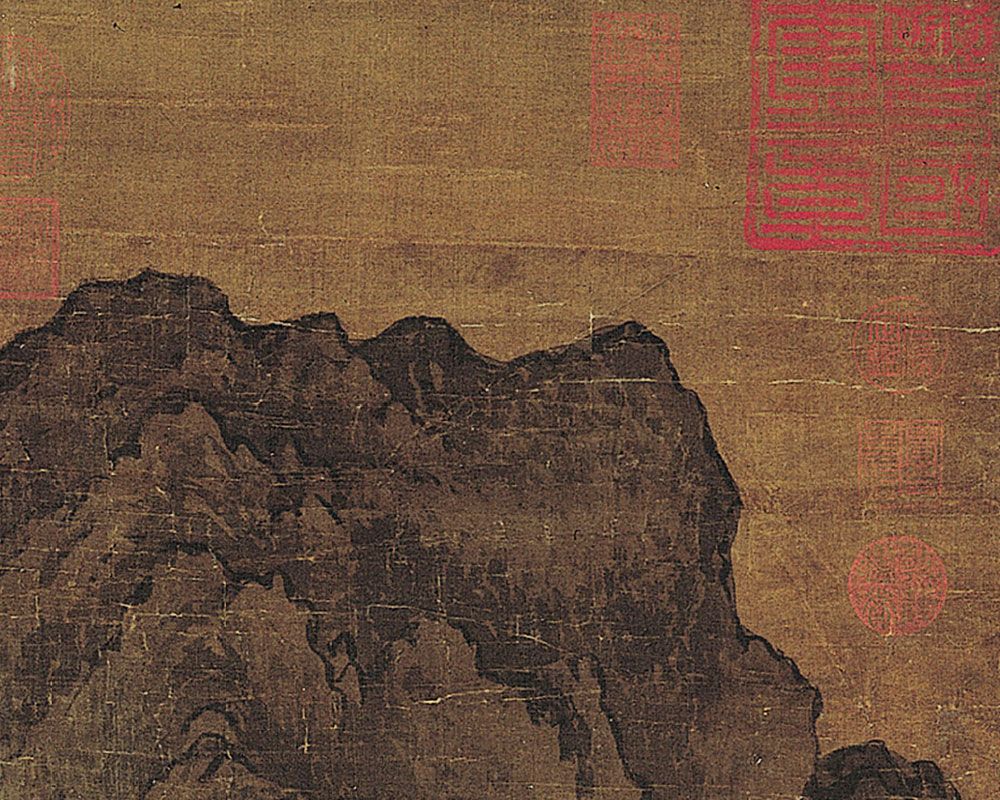
Beyond its technical brilliance, Travelers among Mountains and Passes radiates an atmosphere of "Gu Han" (Desolate Magnificence). Unlike the soft, mist-veiled hills of the South, Guan Tong’s landscape is stark, powerful, and stoic. It represents the scholar’s sanctuary—a place of mental reclusion where one can find stability and truth amidst the chaos of a collapsing empire. To look upon this scroll is to experience a visual meditation, offering a sense of permanent truth that has resonated with connoisseurs for ten centuries.
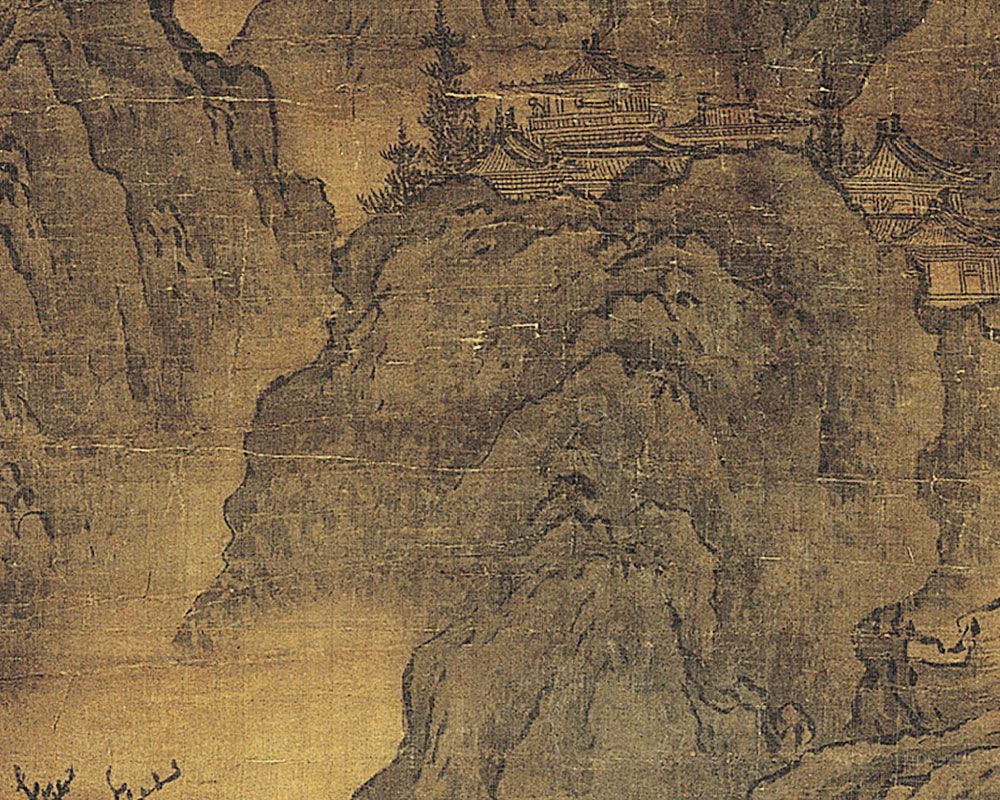
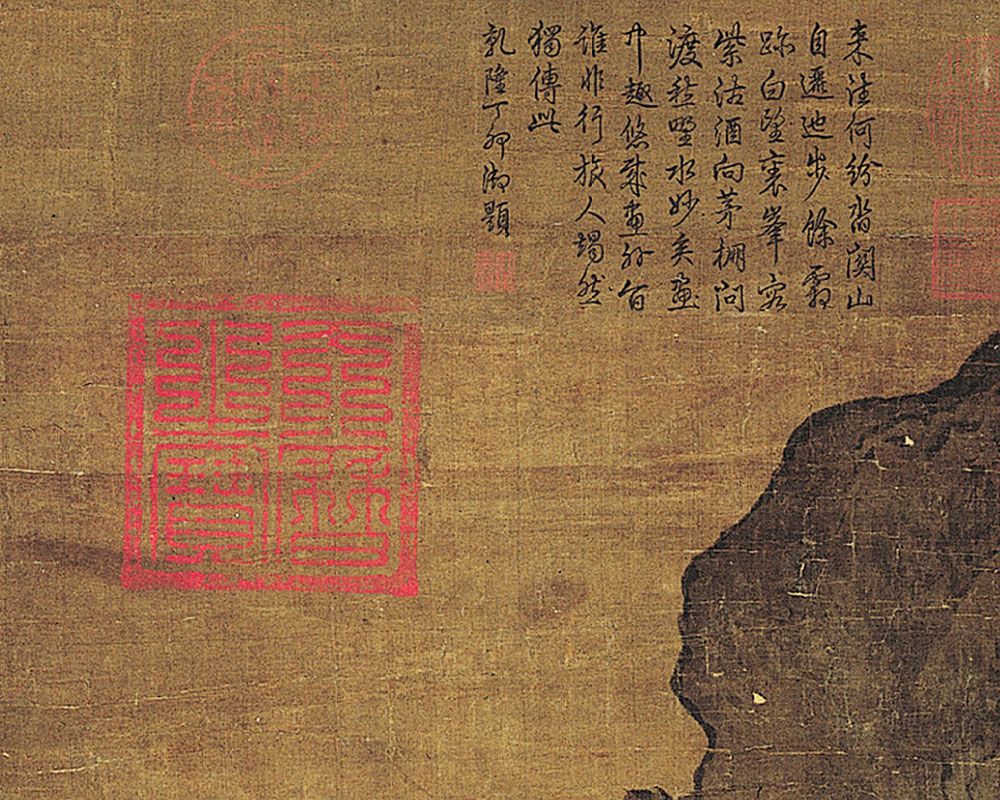
The SinoInArt Collection Edition is defined by its uncompromising commitment to authenticity. The original thousand-year-old silk of Guan Tong’s masterpiece is a fragile national treasure, but SinoInArt has bridged the gap with a faithful 1:1 Museum-Quality Restoration. Utilizing ultra-high-definition scanning and archival-grade Giclée technology, we have captured every nuance of the original masterpiece—from the hairline cracks of the ancient silk to the sharpest edges of the legendary brushwork. Printed on premium long-scroll Xuan paper and hand-mounted with authentic Suzhou Yun Brocade (Cloud Brocade), this edition ensures that the monumental silence of the Five Dynasties becomes a permanent part of your private collection.