
In the hallowed halls of the Forbidden City during the 18th century, a radical new form of art was born—one that harmonized the scientific realism of Europe with the poetic soul of China. At the heart of this movement was Giuseppe Castiglione (1688–1766), an Italian Jesuit missionary known by his Chinese name, Lang Shining. His masterpiece, Flowers and Birds of a Beautiful Spring (Jin Chun Tu / 锦春图), stands as the definitive pinnacle of Qing Dynasty court painting and a symbol of the "High Qing" era’s cultural confidence.
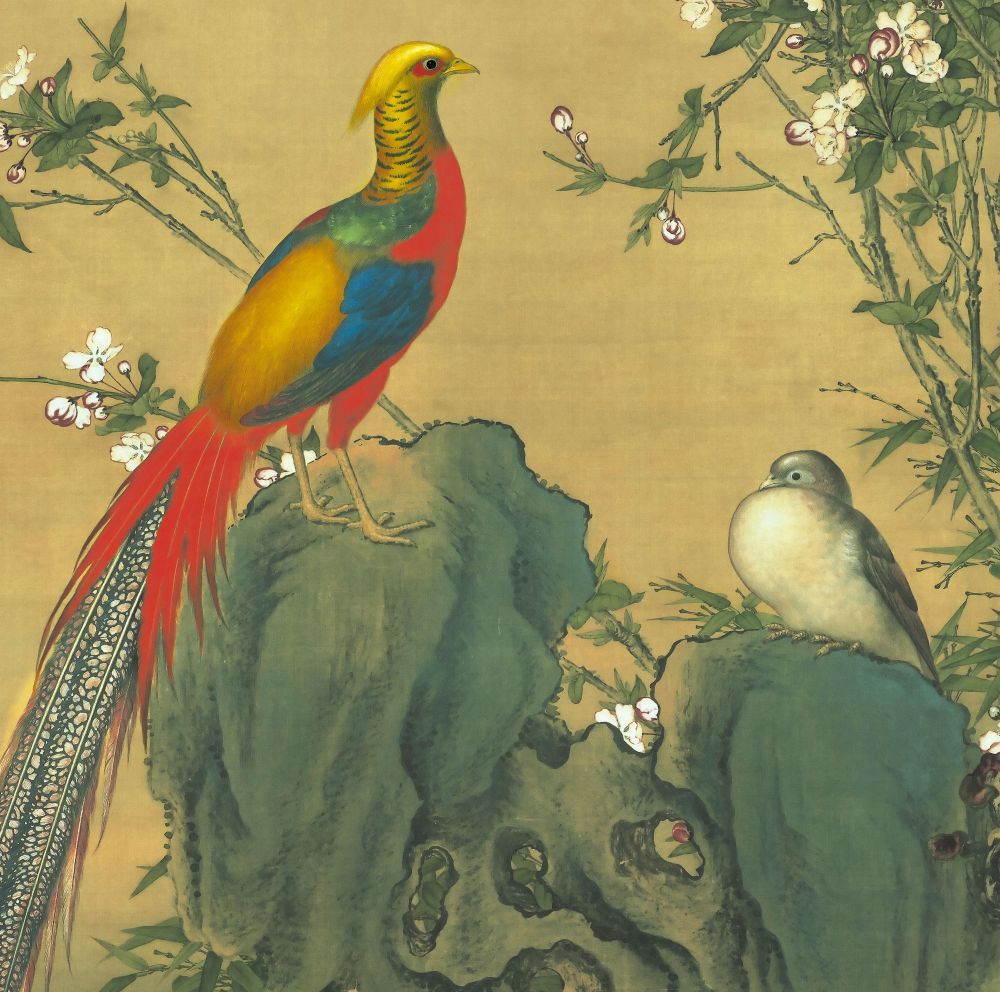
Giuseppe Castiglione served three of China’s most powerful emperors: Kangxi, Yongzheng, and Qianlong. He achieved the extraordinary feat of mastering the brush and silk of the East while retaining the chiaroscuro (light and shadow) and linear perspective of his native Italy. He was the Emperor Qianlong’s favorite artist, entrusted with capturing the majesty of the imperial family and the exotic flora and fauna of the empire. Jin Chun Tu is the ultimate manifestation of his "Sino-Western Synthesis," where the three-dimensional volume of the West meets the linear elegance of the East.
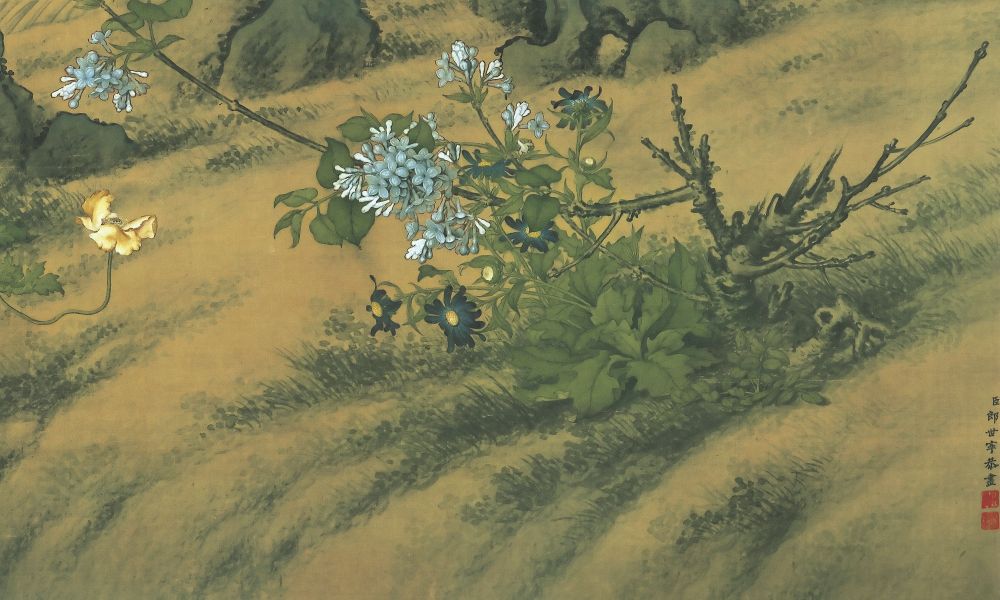
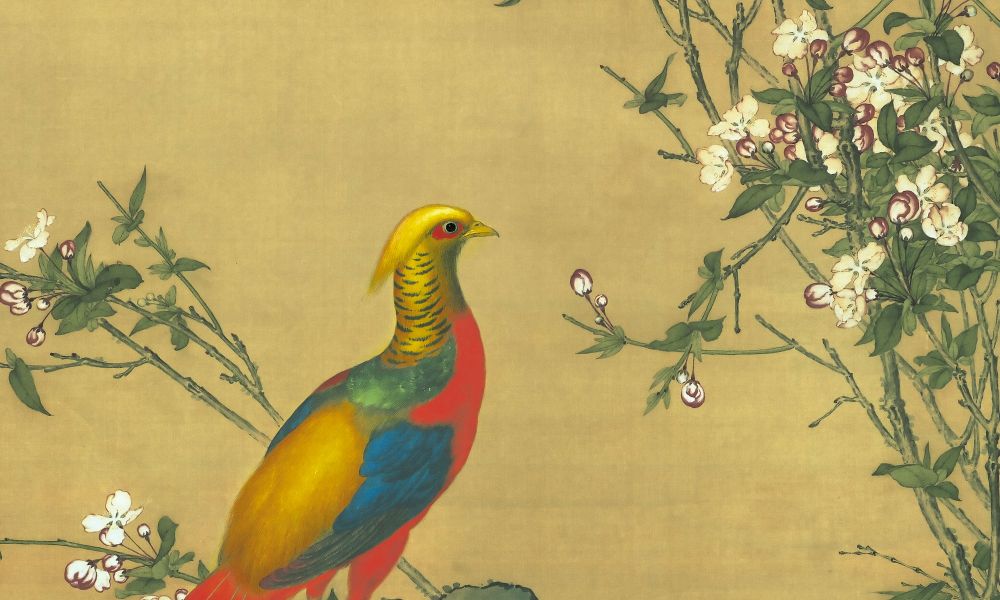
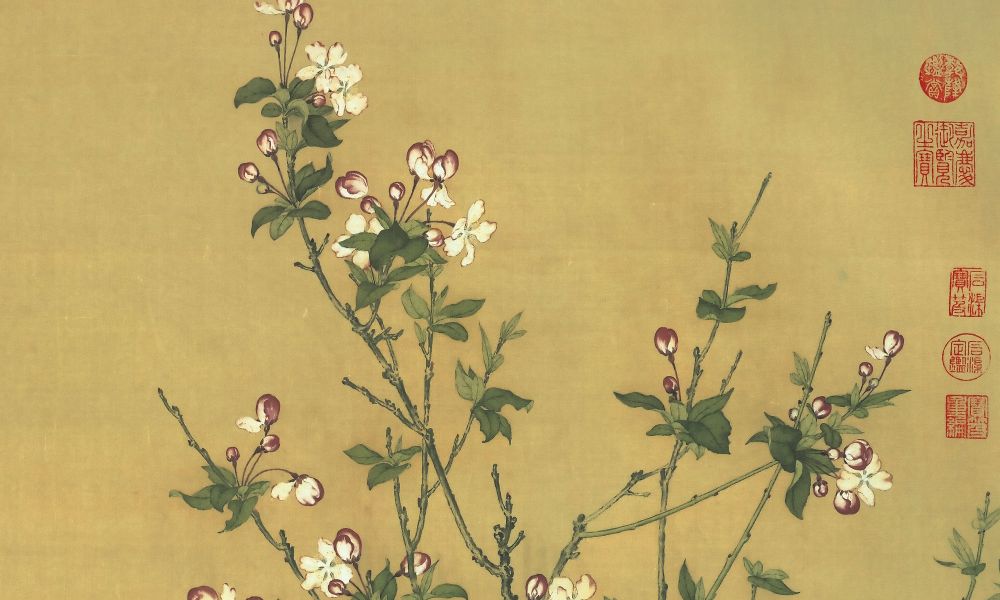
The composition of Jin Chun Tu is a vibrant celebration of life. At its center are two Golden Pheasants (Jinji), perched upon a weathered Taihu Rock. They are surrounded by a lush landscape of blooming peonies, delicate cherry blossoms, and the auspicious Lingzhi (reishi) fungi. What strikes the viewer immediately is the stunning realism of the pheasants. Castiglione treated their feathers not as flat patterns, but as iridescent, textured surfaces that catch the light. Using European oil painting techniques, he created a sense of metallic luster and anatomical volume, making the birds appear as if they could fly off the silk at any moment. The Taihu Rock is rendered with dramatic light and shadow, giving it a rugged, sculptural presence, while the background flowers retain the soft, "boneless" grace of traditional Chinese ink wash.
In the Qing court, a painting was rarely just a painting—it was a vessel for blessings. Jin Chun Tu is saturated with deep cultural symbolism:
- "Jin" (Splendor): The Golden Pheasant (Jinji) is a homophone for "Splendid," representing Jinxiu Qiancheng (a magnificent future).
- The Five Virtues: The pheasant symbolizes the five virtues of a scholar-official: Literacy, Military Prowess, Courage, Benevolence, and Trust.
- Wealth and Longevity: The peony is the "King of Flowers," symbolizing nobility, while the Lingzhi fungus represents immortality.
- Double Fortune: The pair of birds signifies Jin Shang Tian Hua—adding flowers to a beautiful brocade, or making something excellent even better.
SinoInArt is proud to offer an unrivaled 1:1 museum-quality reproduction of this legendary work. Our collection edition is defined by its uncompromising commitment to authenticity, featuring a faithful 1:1 restoration that perfectly preserves the dimensions and proportions of the original masterpiece. Utilizing ultra-high-definition Giclée technology, we have perfectly reproduced the rich, saturated colors of Castiglione’s palette. Each piece is meticulously crafted on specialized Xuan paper and hand-mounted using Suzhou Yun Brocade (Cloud Brocade). This UNESCO-recognized "Royal Fabric," historically reserved for the emperor’s robes, ensures a lifetime of elegance and provides a magnificent frame that matches the painting’s courtly origins.