
Everlasting Spring: Bamboo and Sparrows (长春竹雀图) is a hallmark of 10th-century Chinese art, attributed to the legendary Huang Quan (黄筌). As the foundational figure of the Imperial Painting Academy during the Five Dynasties and Ten Kingdoms period, Huang Quan’s work represents the pinnacle of meticulous realism and courtly elegance.
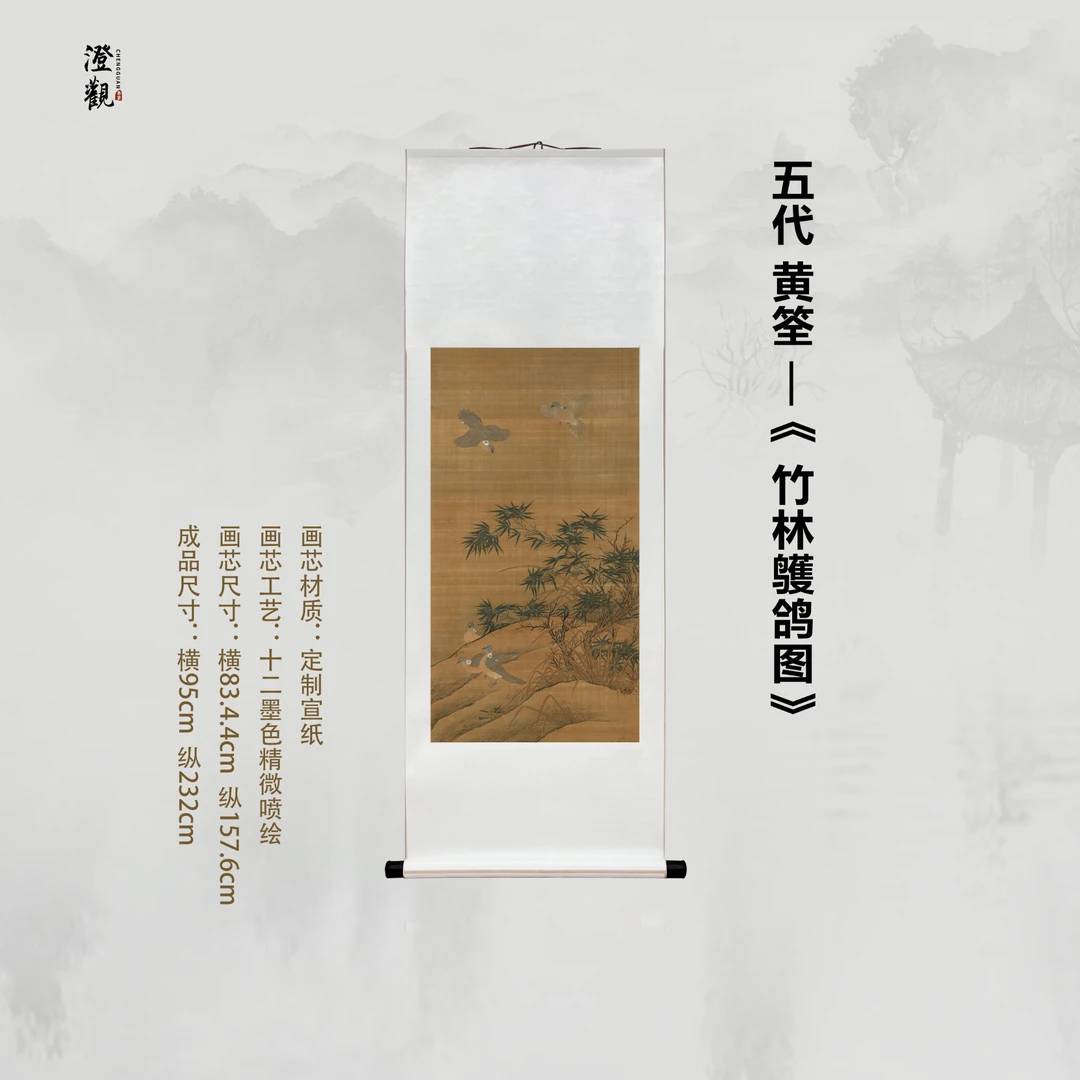
From a technical perspective, this work is a masterclass in the Gongbi (工笔) technique. Huang Quan utilized fine-line drafting (leigang) to define the structure of the bamboo stalks and the delicate anatomy of the sparrows. Unlike the impressionistic styles of later periods, this painting emphasizes physical accuracy. Each feather of the sparrows is rendered with such precision that the birds appear to be caught in a moment of vibrant life, while the bamboo leaves exhibit a waxy, natural sheen achieved through multiple layers of mineral pigment.
The artistic style is the embodiment of "Huangjia Fugui" (黄家富贵), or the "Huang Family’s Opulence." This aesthetic favored rich, saturated colors and a sense of balanced, serene harmony. The "Everlasting Spring" in the title refers not just to a season, but to a perpetual vitality—a wish for longevity and prosperity that was highly favored by the Later Shu court. The interaction between the birds and the foliage creates a rhythmic composition that leads the eye across the scroll in a narrative of natural tranquility.
In terms of symbolism, the pairing of bamboo and sparrows is deeply rooted in Chinese philosophy. Bamboo represents integrity, resilience, and the scholar-gentleman, as it remains green throughout the winter and bends without breaking. The sparrows, often depicted in lively groups, symbolize joy, domestic harmony, and the beauty of the everyday. Together, they form a visual metaphor for a stable and flourishing society.
Historically, this masterpiece serves as a stylistic bridge. It transitioned the bolder, more robust aesthetic of the Tang Dynasty into the refined, academic naturalism of the Northern Song. Today, it remains an essential reference for the study of ancient Chinese ornithology and botanical illustration. It is not merely a painting; it is a cultural monument to the peak of aristocratic artistic achievement.